
Communications & Reporting
Quick reports, QR posters & safety culture
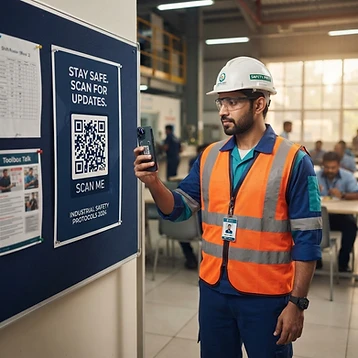
Safety culture starts when everyone can speak — and something happens when they do. SHIELDos puts a QR report poster on every wall: staff, contractors and visitors scan it with any phone and file an HSE quick report in 30 seconds — no app, no login, anonymous if they choose. Every report lands in the HSE team's register with a reference code, is triaged to an owner, and can be converted into an incident, non-conformance or risk action without re-capturing a thing.
Reporters track their own submission with their reference code — so people see that reporting works, and keep reporting.
Key features
- QR report posters per site — print, post, done
- 30-second reporting from any phone: no app, no login
- Anonymous or named — the reporter's choice
- Photo and location capture with every report
- Reference code tracking for the reporter
- Triage to incident, non-conformance or risk action
Scan the poster. File a real report.
This is the actual poster your staff and visitors would see on your walls. Scan it — or tap it on a desktop — and report an HSE concern through the live 30-second flow.
Reports submitted here are triaged in our live demo workspace, exactly as yours would be.
Step 1
Open your camera
No app, no account, no login — any phone camera works, and the report can be fully anonymous.
Step 2
Scan the poster below
This is a real poster from our live demo site — the exact one you would print and post on your walls.
Step 3
Report in 30 seconds
Pick a type, describe it, add a photo — you get a reference code to track your report to closure.

Reports submitted here land in the live SHIELDos demo workspace, where the HSE team triages them from the Quick Reports register — new reports, actions and closures, exactly as your site would run it. Keep your reference code and track it any time.
From the wall to the register
Each branch generates its own printable poster — one QR code per site, so every report knows where it happened. A scan opens the public reporting page: pick what happened (unsafe act, unsafe condition, near miss, concern or suggestion), describe it in a sentence or two, snap a photo if one helps, and submit. The report lands in the HSE register instantly, alerts the site by email, and carries a reference code the reporter can keep.
- One poster per branch — each QR is site-specific
- Email alert to the site the moment a report arrives
- Triage statuses move each report to an owner
- Convert to incident, non-conformance or risk action in one click
- Reporter tracks progress with their reference code
Reporting that feels safe
Anonymity is the reporter's choice, not the system's. Many sites run fully anonymous channels to start the conversation; others encourage named reports so the HSE team can close the loop with the person who raised it. Either way, the reference code keeps the reporter in the loop without exposing who they are.
A conversation, not a suggestion box
Quick reports sit inside your wider safety communications — site notices with acknowledgment tracking, meeting agendas staff can contribute to before the meeting, and pulse surveys that measure whether the culture is actually shifting. Reporting is the start of the conversation, not the end.